
For Healthcare Professionals:
Patients presenting to the emergency department with newly developed vertigo, dizziness, or gait instability are usually evaluated according to the classic framework of “stroke versus acute unilateral vestibulopathy (AUVP).” However, a recent review by Lee et al. shows that up to 50% of these acute cases have a completely different cause, often medical/internal medicine-related or non-ischemic in nature.
🔗 Lee SU, Edlow JA, Tarnutzer AA. Acute Vertigo, Dizziness and Imbalance in the Emergency Department—Beyond Stroke and Acute Unilateral Vestibulopathy—A Narrative Review. Brain Sci. 2025.
The underestimated breadth of acute vestibular syndrome (AVS)
Acute dizziness and sudden gait disturbances are among the most common symptoms in emergency departments, accounting for about 2.1 to 4.4% of all cases. The major challenge: Around half of these patients have an underlying systemic disease that does not primarily originate from the cerebral vessels (stroke) or the balance organ in the inner ear (AUVP). This means that the spectrum of causes of true AVS is far broader than the two classic diagnoses. About 15% of these internal medicine–related and drug-induced causes are potentially life-threatening, but highly treatable if diagnosed in time.
Dangerous neurological causes (beyond stroke)
When the cause lies in the central nervous system, it does not necessarily have to be a cerebral infarction or a brain hemorrhage. The following conditions can trigger a true acute vestibular syndrome:
- Wernicke encephalopathy (thiamine/vitamin B1 deficiency): This neurological emergency occurs acutely after prolonged vomiting, for example during pregnancy, malnutrition, or chronic alcohol abuse. Typical features include marked gait instability and subtle eye movement abnormalities, such as an initially upward-beating and later downward-beating nystagmus, or gaze-evoked nystagmus.
→ Clinical practice tip according to the publication: If there is justified suspicion, high-dose thiamine (200–500 mg 3 times daily) must be administered intravenously immediately — even before laboratory results are available!
- Demyelinating diseases (e.g. multiple sclerosis): Acute MS plaques in the brainstem or at the entry zone of the vestibular nerve fiber can trigger an acute vestibular syndrome with central oculomotor disturbances.
- Space-occupying lesions of the posterior fossa: Benign or malignant tumors, such as brainstem gliomas or cerebellar metastases, can directly compress the central vestibular pathways. When tumor growth exceeds the brain’s compensatory mechanisms or surrounding edema develops, dizziness, gait ataxia, and vomiting can begin suddenly or worsen dramatically, which can then clinically appear, incorrectly, like an acute stroke.
- Vestibular migraine: The very first severe dizziness attack of vestibular migraine is often misinterpreted as a stroke in the acute setting. Cases are documented in the medical literature in which patients mistakenly received intravenous thrombolysis — a potent medication used to dissolve blood clots — because the symptoms could not be clearly differentiated.
Dangerous non-neurological causes
If affected patients do not have nystagmus and the symptoms do not worsen markedly with head movements, internal medicine-related triggers become more likely:
- Medication intoxication: Excessively high therapeutic levels of centrally acting medications such as antiepileptic drugs (phenytoin, carbamazepine, oxcarbazepine) or lithium can trigger severe acute dizziness and coordination disorders.
- Cardiovascular emergencies: Acute cardiac arrhythmias, myocardial infarction, pulmonary embolism, or life-threatening aortic dissection can lead to acute dizziness through a sudden drop in blood pressure and cardiac output.
- Electrolyte disturbances and metabolic derangements: Marked sodium deficiency (hyponatremia), severe magnesium deficiency (hypomagnesemia — often associated with downbeat nystagmus), or an acute drop in blood glucose (hypoglycemia) must be ruled out by laboratory testing.
Important for clinical practice (decompensation): Acute physical stressors such as high fever, infections, dehydration, or oxygen deficiency can reactivate an old injury to the balance organ — one that the brain had actually compensated for well long ago — for example after an episode that occurred years earlier Neuritis) can suddenly become apparent again. Affected patients decompensate and may present in the emergency department like an acute medical emergency.
The structured path to diagnosis: TiTrATE
To quickly move in the right diagnostic direction during the hectic routine of the emergency department, the systematic TiTrATE concept is helpful:
- Timing (How long have the symptoms been present? Did they begin suddenly or gradually?)
- Triggers (Are the episodes triggered by specific stimuli such as head positioning or standing up quickly?)
- And Targeted Examination (targeted examination: performing the HINTS test for stroke diagnosis, targeted positional testing, as well as a thorough assessment of balance, stance, and gait).
👉 Are you interested in a comprehensive further training in vestibular rehabilitation and how to correctly interpret the clinical signs of these complex causes of dizziness and how to rehabilitate affected patients safely and in a targeted way after the acute phase?
Current further education opportunities and course dates can be found in the IVRT Course search.
For Patients – Easy to Understand
Dizziness in the emergency department: it is not always stroke or vestibular neuritis
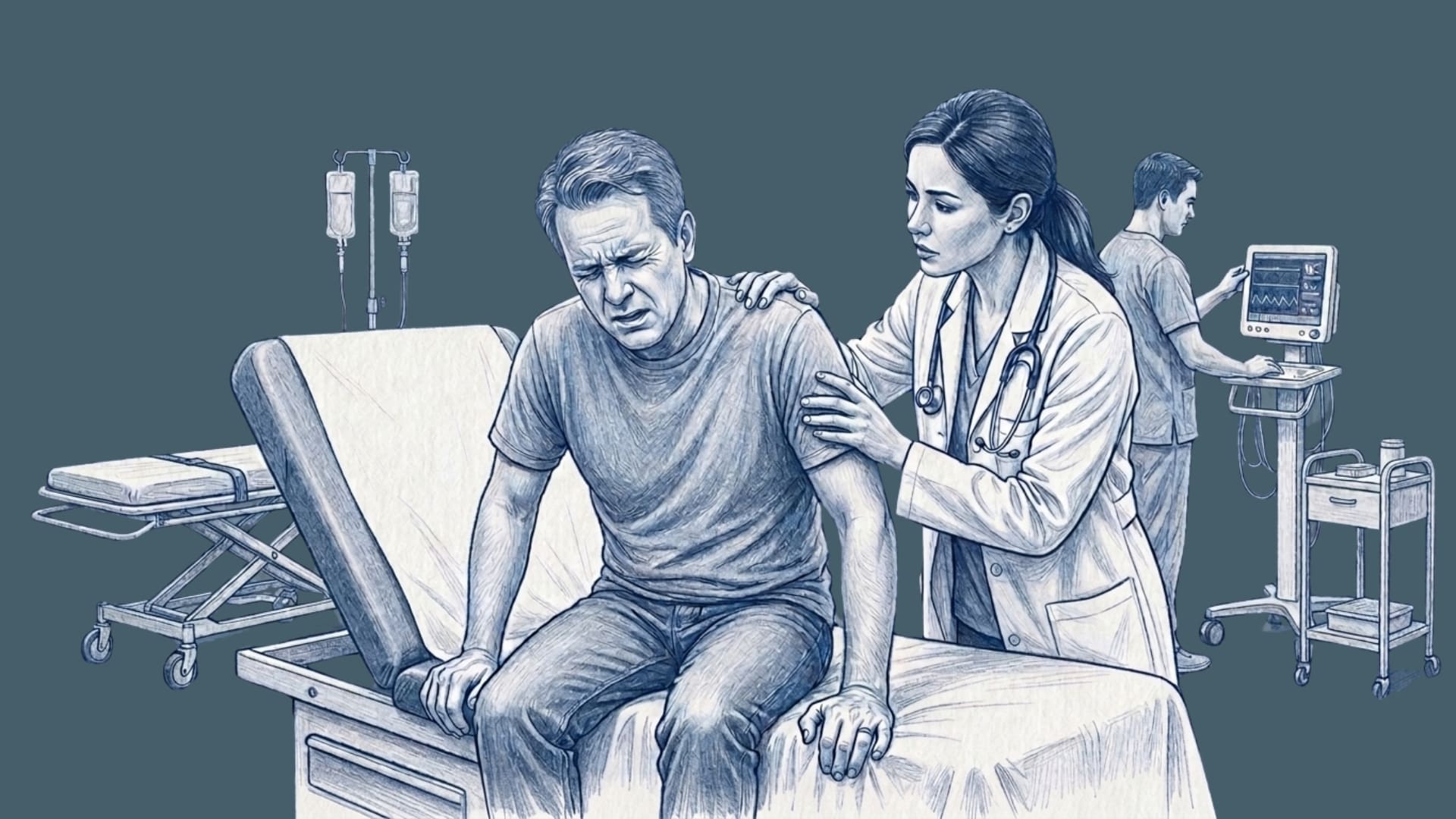
When you suddenly develop severe vertigo, experience persistent vomiting, and can barely stay on your feet, the usual destination is the emergency department. The biggest concern is almost always: Is it a stroke? Or is it an inflammation of the inner ear?
However, a large review study shows that in nearly half of all patients, acute dizziness has a completely different cause originating elsewhere in the body.
📄 Lee SU, Edlow JA, Tarnutzer AA. Acute Vertigo, Dizziness and Imbalance in the Emergency Department—Beyond Stroke and Acute Unilateral Vestibulopathy—A Narrative Review. Brain Sci. 2025.
Here is a simple overview of what may be responsible — apart from stroke and the ear:
1. Problems in the brain that are not a stroke
The brain controls our balance. But it can also be disrupted by other acute problems:
- A sudden, severe vitamin deficiency (vitamin B1): If someone has been vomiting severely for days, for example during pregnancy, or is very poorly nourished, the brain can quickly lack important nutrients. This leads to severe dizziness, visual disturbances, and extreme unsteadiness when walking. The good news: If the vitamin is given quickly as an injection or infusion, the brain usually recovers rapidly.
- Multiple sclerosis (MS): If a new inflammatory MS lesion develops exactly where the balance nerves enter the brain, it can trigger severe dizziness from one moment to the next.
- Lumps or swelling (tumors): If a tumor grows in the back part of the head, it may eventually press on the balance pathways. This can cause dizziness and nausea to suddenly become much worse.
- The vestibular migraine: This is a form of migraine that does not cause headache but instead leads to severe vertigo. People experiencing it for the first time often arrive at the hospital in a state of panic because it can feel exactly like a stroke.
2. Problems that are not located in the brain (medical/internal causes)
Sometimes the balance organs and the brain are completely healthy, but another problem in the body interferes with them:
- Side effects of medication: Certain tablets, especially those used for seizures, severe pain, or sedation, can suppress the brain so strongly that a person becomes persistently dizzy if the dose is too high.
- Cardiovascular emergencies: If the heart suddenly starts beating irregularly, if someone is having a heart attack, or if there is a clot in the lung (pulmonary embolism), blood pressure drops. The brain receives too little blood for a moment and immediately signals: dizziness!
- Abnormal salt levels in the blood: After a severe gastrointestinal infection, a person may lose too much fluid and important body salts, such as sodium or magnesium. This disrupts the body’s entire electrical system and can cause extreme dizziness and shakiness.
3. The mystery of “reactivated” dizziness
A very common reason for emergency department visits is what is known as decompensation. This means: Perhaps you had inflammation of the vestibular nerve. Your brain learned to compensate for this damage at the time.
But if you now develop a high fever, a severe infection, or extreme dehydration, your brain becomes overloaded. It can no longer maintain the compensation. The old dizziness suddenly flares up again and feels like a brand-new emergency, even though nothing new has happened in the ear.
What can you do?
In the emergency department, physicians use a structured approach (TiTrATE) to determine the cause of the symptoms. They assess the timing and triggers of the dizziness and perform a focused examination of the eyes and gait (Targeted Examination).
You can help the team most if you have the following ready:
- An up-to-date medication list.
- Information about whether you had been fasting, had a fever, or had been vomiting for days beforehand.
- Precise information about whether the dizziness came on by itself while lying down, or only when you moved your head or stood up.
🎯 Our IVRT®-certified dizziness and vestibular therapists support you: After the physicians in the emergency department have ruled out dangerous causes, we can help. With highly targeted, scientifically validated exercises we will help your brain relearn how to restore physical stability, so that you can regain confidence and safety in everyday life. Find specialized colleagues in our IVRT therapist search