Medical Technology
for vestibular diagnostics & rehabilitation
On this page, physicians, therapists, and medical professionals are provided with a clearly structured overview of modern diagnostic and measurement systems for the assessment and treatment of dizziness and balance disorders. The information is intended for professional orientation and supports the selection of appropriate diagnostic and rehabilitative procedures.
Among other things, devices are presented for the Video Head Impulse Test (vHIT), the Video Nystagmography (VNG), the Cranio-Corpography (CCG), the determination of the Subjective Visual Vertical (SVV), the measurement of Dynamic Visual Acuity (DVA) and Static posturography. This provides a complete setup for precise, guideline-compliant diagnostics in vestibular medicine.
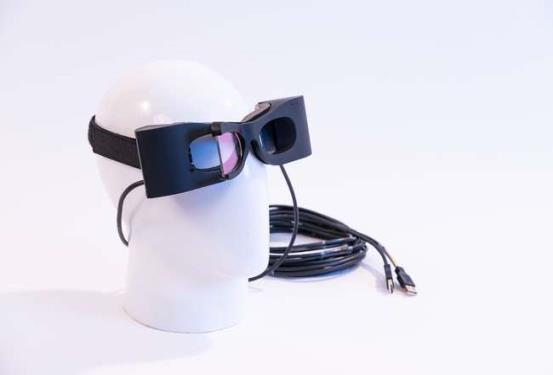
Video Head Impulse Test (vHIT)
The Video Head Impulse Test (vHIT) enables the assessment of all six semicircular canals at high stimulus frequencies.
Features:
- Fast testing: all six semicircular canals can be tested individually in approximately 10 minutes.
- High-frequency motion sensor for precise recording of head movements and simultaneous comparison of head and eye movements.
- Monocular high-speed camera with 200 frames per second for capturing rapid eye movements.
- Lightweight goggle frame to minimize slippage.
- Integrated lasers for calibration.
Video Nystagmography (VNG)
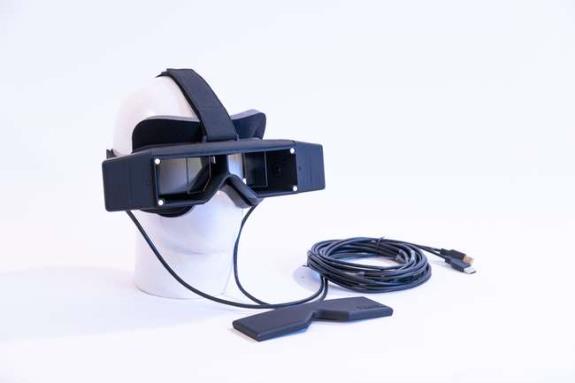
The Video Nystagmography (VNG) is one of the most advanced techniques for observing, measuring, and analyzing eye movements during oculomotor, caloric, positional, and vestibular test procedures. Peripheral and central vestibular functions are assessed using the following examinations:
- Spontaneous nystagmus – with and without visual fixation
- Gaze-evoked nystagmus
- Saccades – randomized
- Slow pursuit movements (smooth pursuit) – at different frequencies
- Optokinetic test
- (Head Shaking Test)
- Positional tests including the Dix–Hallpike maneuver, supine head roll test, and deep head-hanging test
- Valsalva- and hyperventilation-induced nystagmus
- Skew Deviation
Features:
- Binocular system
- High-frequency camera
- Recordings of eye movements can be viewed during and after the test.
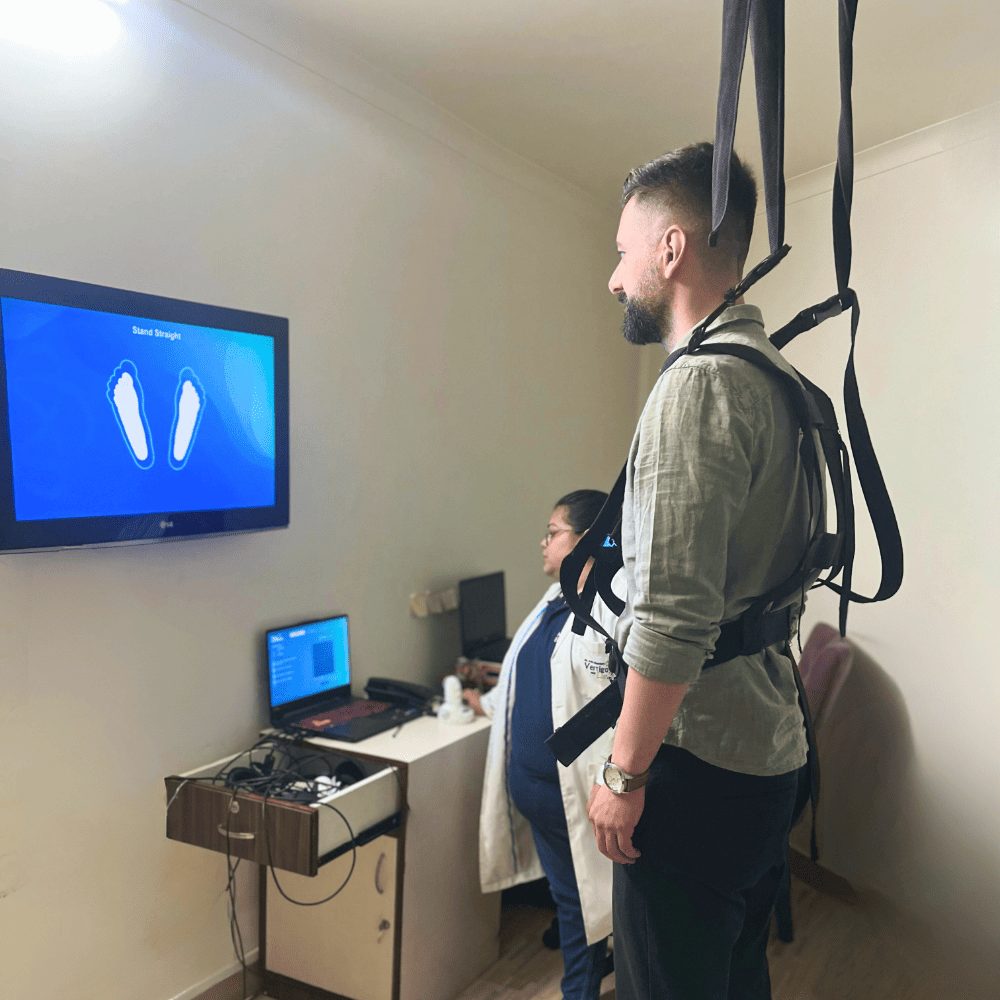
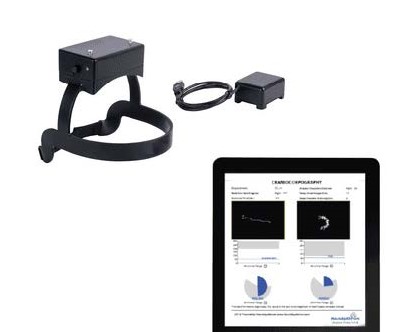
Cranio-Corpography (CCG)
This is an examination for assessing the vestibulospinal reflex, which is responsible for maintaining balance during locomotion. Among others, the following tests are evaluated:
- Romberg test
- Tandem gait
- Unterberger test
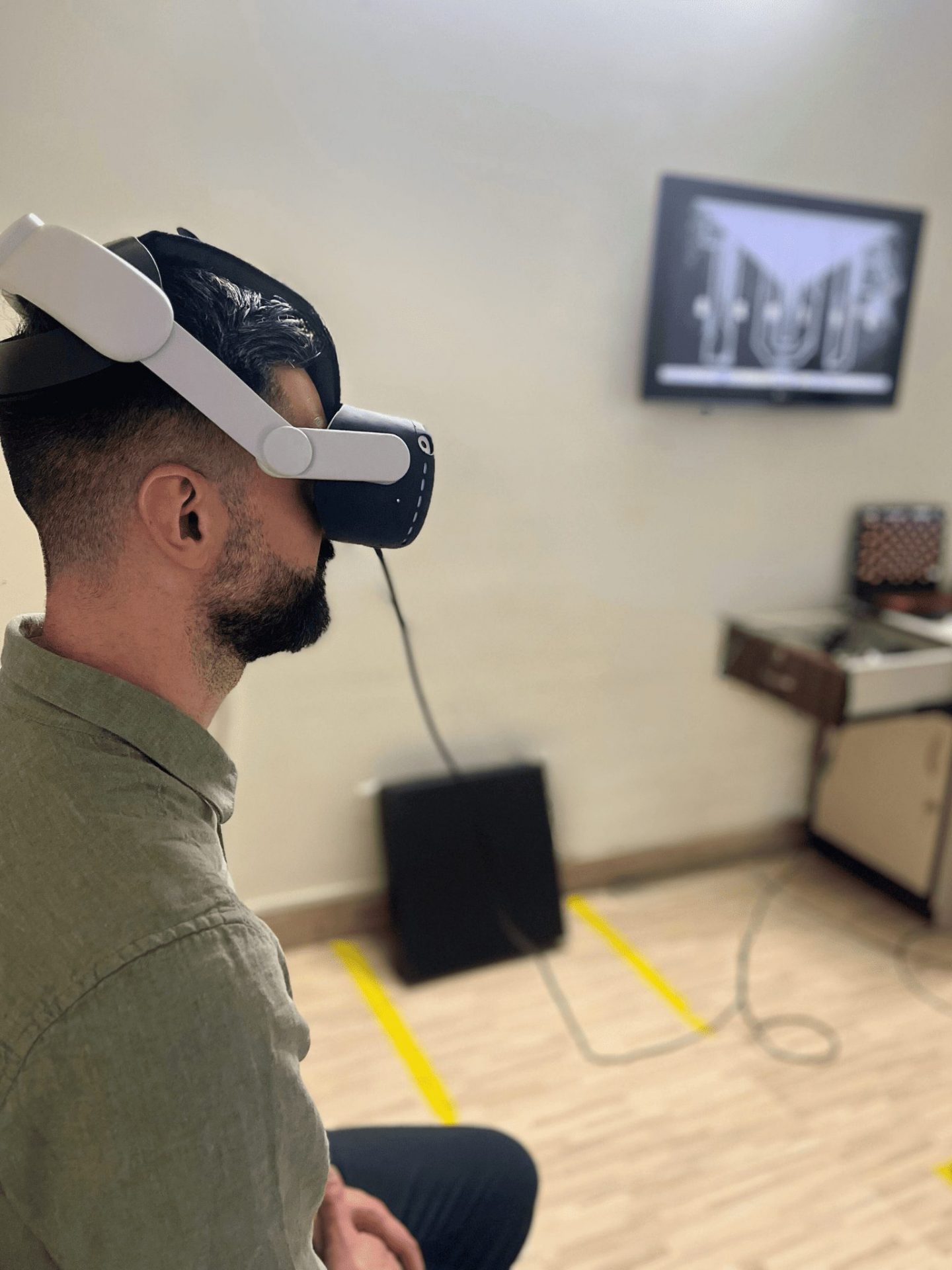
Subjective Visual Vertical (SVV)
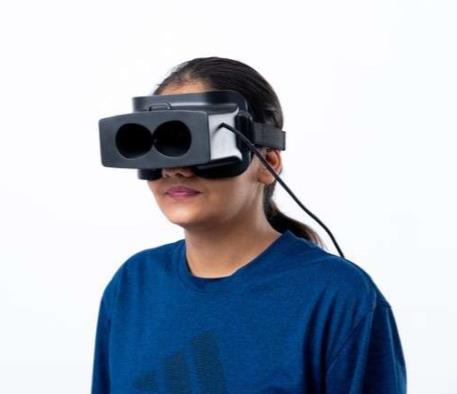
The Subjective Visual Vertical (SVV) measures the perception of the body’s vertical axis and is a sensitive test for vestibular disorders of the inner ear.
This examination is used to assess the otolith organ (in particular the utricle), which is responsible for the perception of verticality.
Performed tests:
• Static Subjective Visual Vertical (SVV) – head upright
• Static Subjective Visual Vertical (SVV) – head tilted by 30°
• Dynamic background – head upright
Dynamic Visual Acuity (DVA)
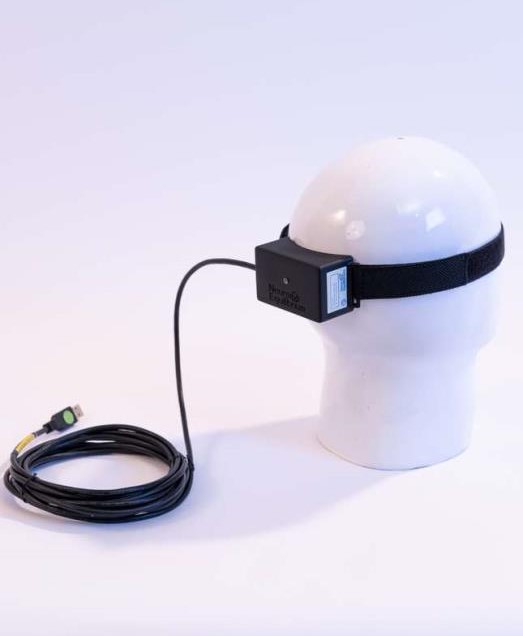
The dynamic visual acuity (DVA) is useful for:
- Early detection of vestibulotoxicity
- Detection of bilateral peripheral vestibulopathy
- Use as a rehabilitation tool
- Assessment of rehabilitation outcomes
DVA assesses a person’s ability to keep an image stable on the fovea of the retina. This function is enabled by the vestibulo-ocular reflex (VOR) . If the VOR is impaired, the image slips off the fovea, resulting in blurred vision, which can be reliably detected by DVA.
Static posturography
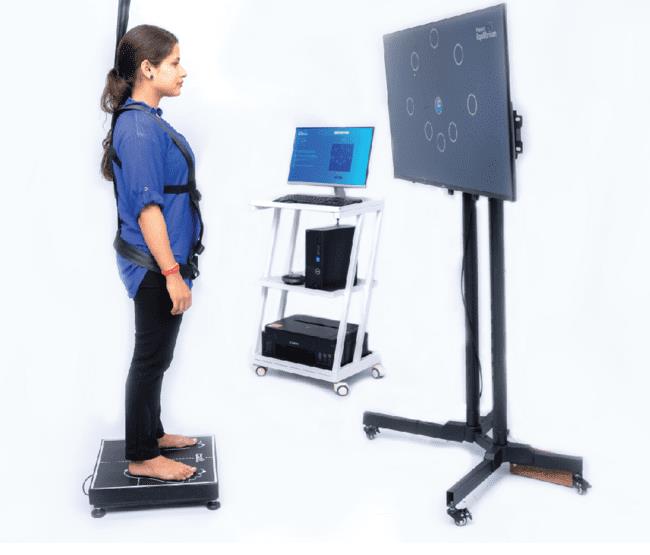
The posturography is an objective and functional examination of the postural control system under conditions of stable equilibrium. It is also highly suitable for evaluating the success of vestibular rehabilitation.
It includes, among others, the following test procedures:
- Modified Clinical Test of Sensory Interaction on Balance (mCTSIB)
The mCTSIB assesses functional balance control based on the patient’s postural sway velocity under four test conditions. The results are displayed graphically, including the center of gravity (COG) trajectories for each condition performed. - Limits of Stability (LOS)
The LOS test determines how far a patient can intentionally shift their center of mass in different directions without losing stability. Measured parameters include reaction time, speed of center-of-mass movement, directional control, endpoint excursion, and maximum excursion. - Rhythmic Weight Shift (RWS)
The RWS test measures the patient’s ability to rhythmically shift the center of mass between two targets to the left/right as well as forward/backward at different speeds. The evaluated parameters are center-of-mass velocity and directional control.
The posturography is available in two versions:
- posturography with mCTSIB (basic version)
- posturography with mCTSIB, Limits of Stability (LOS), and Rhythmic Weight Shift (RWS)
Product inquiry
We will get back to you as soon as possible.
Note:
These medical devices are CE-certified in accordance with EU Regulation 2017/745 (MDR) and are intended exclusively for use by medically trained professionals. Please observe the enclosed instructions for use.
Support with setup (online) and training is provided by the manufacturer.