For Healthcare Professionals:
Helps vestibular rehabilitation at vestibular migraine at all? This question is frequently asked in clinical practice. A new systematic review with meta-analysis provides an encouraging result: the vertigo burden improved significantly on average and to a clinically relevant degree.
📄 El Ahdab J, Vilardo M, Ong B, et al. The effect of vestibular rehabilitation in the management of vestibular migraine in adults: A systematic review and meta-analysis. Headache. 2026;66(1):77–87. doi:10.1111/head.70002.
What was examined?
The authors summarized seven studies involving a total of 413 adult patients with vestibular migraine. The mean age was 45.4 years, and 76 % of the participants were women.
The focus was on the change in the Dizziness Handicap Inventory (DHI). The DHI assesses the extent to which dizziness impairs daily life physically, functionally, and emotionally.
The most important result: an average of 29.3 fewer DHI points
During vestibular rehabilitation, the DHI decreased by an average of 29.3 points. The 95% % confidence interval ranged from −40.2 to −18.3 points.
A change of about 18 points is frequently considered clinically relevant. The average improvement was thus clearly above this threshold.
The result suggests that vestibular rehabilitation can achieve more than just a small statistical change in vestibular migraine. Many patients can achieve a noticeable reduction in their dizziness-related limitations.
What content was used for training?
The programs were not uniform. Frequently used were:
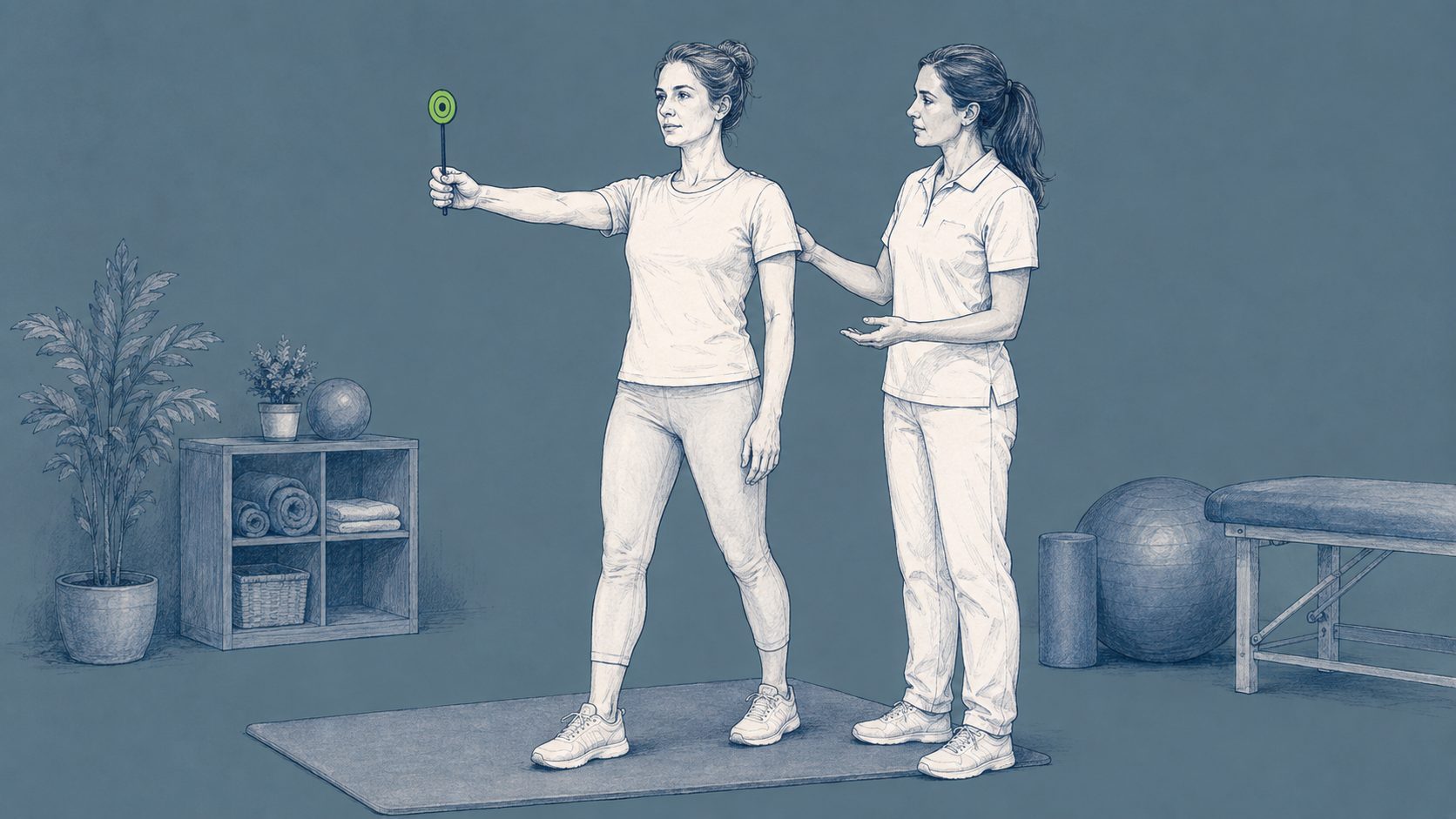
- Gaze stabilization– and adaptation exercises
- Habituation exercises for movement- or visually induced symptoms
- Balance and gait training
- supervised exercises in the clinic and complementary home programs
The duration also differed significantly: the programs ranged from four to approximately 30 weeks.
Thus, while the meta-analysis shows that vestibular rehabilitation can be helpful in principle, it does not yet answer which specific exercise program is best suited for which patients.
Why the result must still be interpreted with caution
Statistical heterogeneity was very high, with I² = 94.7 %. The results of the individual studies therefore differed significantly.
Possible reasons include differing study designs, rehabilitation programs, treatment durations, concomitant medications, and patient groups.
Furthermore, an average improvement of 29.3 points does not mean that every single person benefits to that extent. The available data indicate a clinically relevant benefit. However, they do not yet allow a definitive conclusion as to who responds particularly well and how large the effect would be under a standardized protocol.
What does this mean for practical application?
Vestibular migraine should not be treated with a rigid standard program. An individual selection and dosage of exercises based on the specific symptoms and findings is useful.
Depending on the patient, movement tolerance, visual endurance, balance, or gait stability may be the primary focus.
Vestibular rehabilitation is part of a comprehensive treatment concept. This also includes a confirmed diagnosis, patient education, medical treatment of the migraine, and—if necessary—medication prophylaxis.
Especially with pronounced sensitivity to stimuli, the load should be increased gradually and adjusted regularly.
Conclusion
The new meta-analysis provides the clearest aggregated signal to date: vestibular rehabilitation can significantly and clinically relevantly reduce dizziness-related impairment in vestibular migraine.
Due to the large differences between the studies, standardized randomized trials and subgroup analyses remain necessary.
In practice, this means that vestibular rehabilitation is a sensible treatment option, but it should be planned and dosed individually.
👉 Are you interested in a comprehensive further training in vestibular rehabilitation and want to learn how to specifically assess and treat patients with vestibular migraine?
Current further education opportunities and course dates can be found in the IVRT Course search.
For Patients – Easy to Understand
Vestibular migraine: Can targeted balance training help?
At a vestibular migraine headaches are not always the primary symptom. Many sufferers primarily experience dizziness, unsteadiness when walking, nausea, or a high sensitivity to movement and visual stimuli.
For example, crowded supermarkets, quick head movements, or moving images can trigger symptoms.
A new review summarized seven studies with a total of 413 patients. The participants completed a vestibular rehabilitation – so targeted training for gaze stability, motion tolerance, and balance.
Source
El Ahdab J, Vilardo M, Ong B, et al. The effect of vestibular rehabilitation in the management of vestibular migraine in adults: A systematic review and meta-analysis. Headache. 2026;66(1):77–87. doi:10.1111/head.70002.
How strong was the improvement?
The burden of the dizziness was measured using a questionnaire, the Dizziness Handicap Inventory (DHI).
On average, the value improved by 29.3 points. A change of around 18 points or more is considered clearly noticeable. The result was therefore well above that.
What is done during the therapy?
The training can look different depending on the symptoms. These include, for example:
- exercise, where the gaze remains fixed on a target during head movements
- a slow buildup of tolerance to movement or visual stimuli
- Balance and walking exercises
- an individually dosed home program
Does this help all those affected?
Not automatically. The results of the individual studies varied widely. The training programs also lasted between four and approximately 30 weeks.
Therefore, it cannot yet be said which program is best for each person.
It is important that the diagnosis is medically confirmed and that the exercises match one's specific symptoms. A program that is too difficult or progressed too quickly can cause temporary increased irritation. The exercises should therefore be individually selected and adapted.
In short
Current research shows: Vestibular rehabilitation can help significantly with vestibular migraine.
It does not replace medical migraine treatment, but it can be a useful supplement and help you feel more secure and resilient in everyday life.
🎯 Our IVRT®-certified dizziness and vestibular therapists Do you support: IVRT therapist search
 Deutsch
  English
  Nederlands
  Dansk
Dansk  Türkçe
