
For Healthcare Professionals:
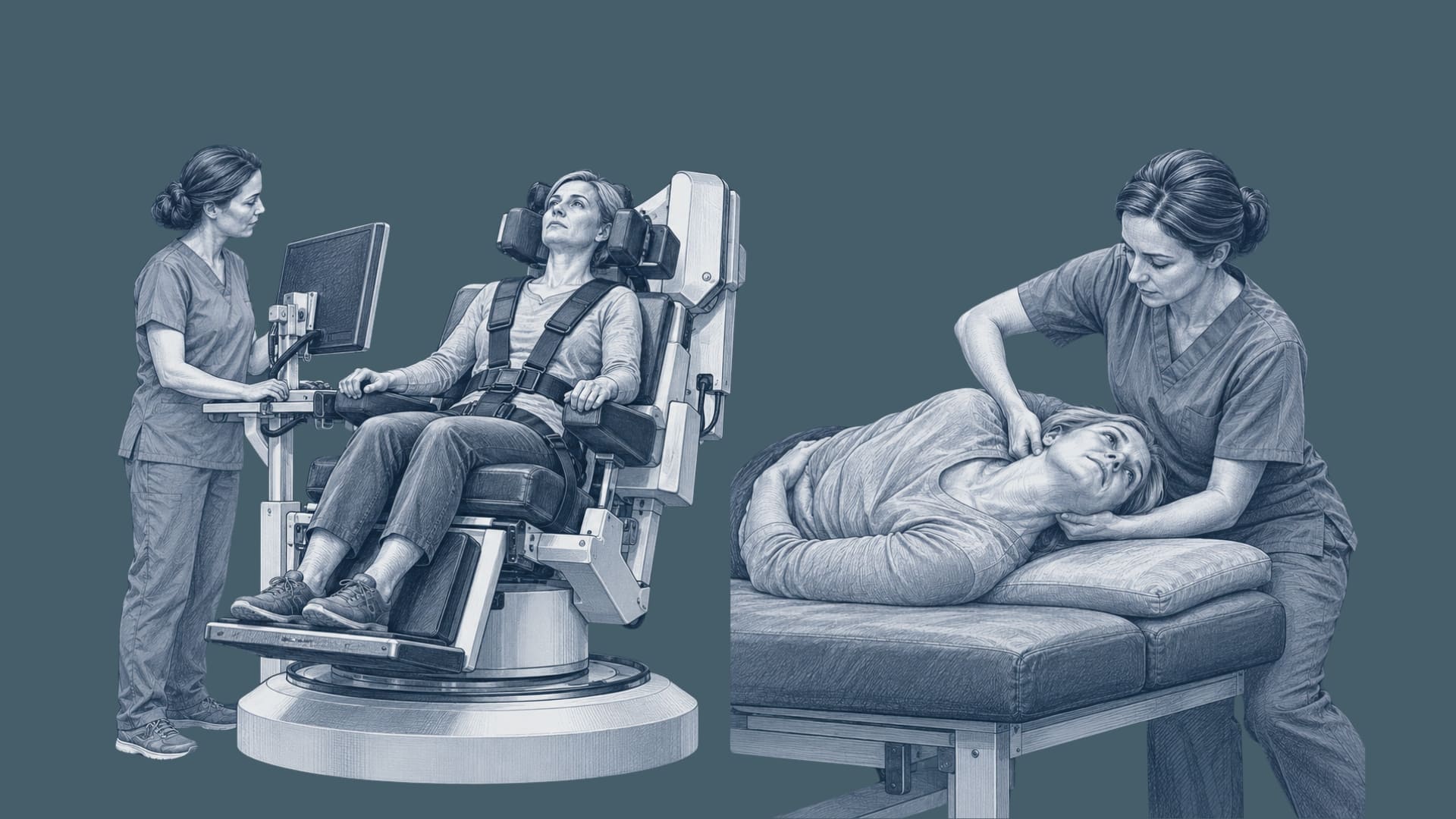
Mechanical rotation chairs allow for controlled movements and standardized positioning. But does this elaborate technique lead to an uncomplicated Benign paroxysmal storage dizziness (BPLS) actually leads to better results than properly performed manual Manoeuvre? A new prospective randomized study provides a rare direct comparison in this regard.
The study in brief
Marta Chaure-Cordero and Eduardo Martin-Sanz studied 102 adults with uncomplicated BPLS. The participants were assigned to treatment with the mechanical TRV rotation chair or manual positioning and release maneuvers. 89 people completed the twelve-month follow-up: 44 in the rotating chair group and 45 in the manual group.
Among other things, the following were examined:
- the number of maneuvers until successful treatment
- the change in the Dizziness Handicap Inventory
- the subjective vertigo intensity on a visual analog scale
- Recurrences during the twelve-month follow-up
No statistically significant advantage of the rotating chair
Until the complaint resolution, the rotating chair group required an average of 2.25 maneuvers, while the manually handled group required 1.82 maneuvers. The difference was not statistically significant (p = 0.190). Also, no advantage of either method was shown in the patient-reported complaints.
| Result | TRV Swivel Chair | Manual maneuvers |
| Manoeuvre until dissolution | 2,25 ± 1,78 | 1,82 ± 1,23 |
| DHI before and after treatment | 47.2 to 10.6 | 41.4 to 11.6 |
| Dizziness VAS before and after treatment | 5.3 to 0.86 | 4.3 to 0.86 |
In both groups, DHI and dizziness intensity decreased significantly. However, the researchers found no statistically significant differences between the groups. The recurrence rates also did not differ clearly.
Manual treatment remains convincing for uncomplicated BPLS
The results show that a mechanical rotation chair does not automatically produce better treatment outcomes in uncomplicated BPLS. Properly performed manual maneuvers resulted in a comparable improvement in symptoms and quality of life.
This does not make the swivel chair unnecessary. The authors see a potential benefit especially in people whose mobility makes manual positioning difficult. Mechanized systems can also be clinically interesting for selected complex or difficult cases. However, this study does not address exactly these patient groups, because it specifically examined uncomplicated cases.
Age, trauma, osteoporosis and previous BPLS episodes
Regardless of the treatment method, older female patients and people with a history of head trauma tended to require more procedures. Osteoporosis and previous BPLS episodes were associated with a higher risk of recurrence. These results are from complementary analyses and should not be understood as evidence of a causal relationship.
What the study does not prove
The absence of a statistically significant difference does not prove complete equivalence. The study was conducted as an open randomized study and was not described as a formal noninferiority or equivalence study. 13 of the 102 randomized participants did not complete the follow-up period. Furthermore, the results cannot be readily transferred to complex, multi-channel, or therapy-fraktory BPLS forms.
The study also compares not just two maneuvers, but two treatment settings. Experience, diagnostic accuracy, and the correct selection of the maneuver can influence the outcome regardless of the aid used.
What does this mean for practice?
- In uncomplicated BPLS, manual storage and release maneuvers remain an effective treatment option.
- The technical equipment does not replace the correct determination of the affected bend and the side, nor does it replace proper execution.
- A rotating chair may be useful for selected people with limited mobility or in specialized centers. This study does not prove any general benefit.
- Complex or recurring cases require a differentiated diagnosis and cannot be conclusively assessed by this study.
Conclusion
In uncomplicated BPLS, the 3D swivel chair was not superior to manual maneuvers. Both procedures significantly reduced dizziness and DHI. For healthcare providers, this means that high-tech can be helpful in selected situations, but the quality of the care is still crucial. diagnostics and the correct execution of the appropriate maneuver remains crucial.
👉 Are you interested in a comprehensive further training in vestibular rehabilitation?
Current further education opportunities and course dates can be found in the IVRT Course search.
 Deutsch
 English
 Nederlands
 Dansk
 Türkçe

