
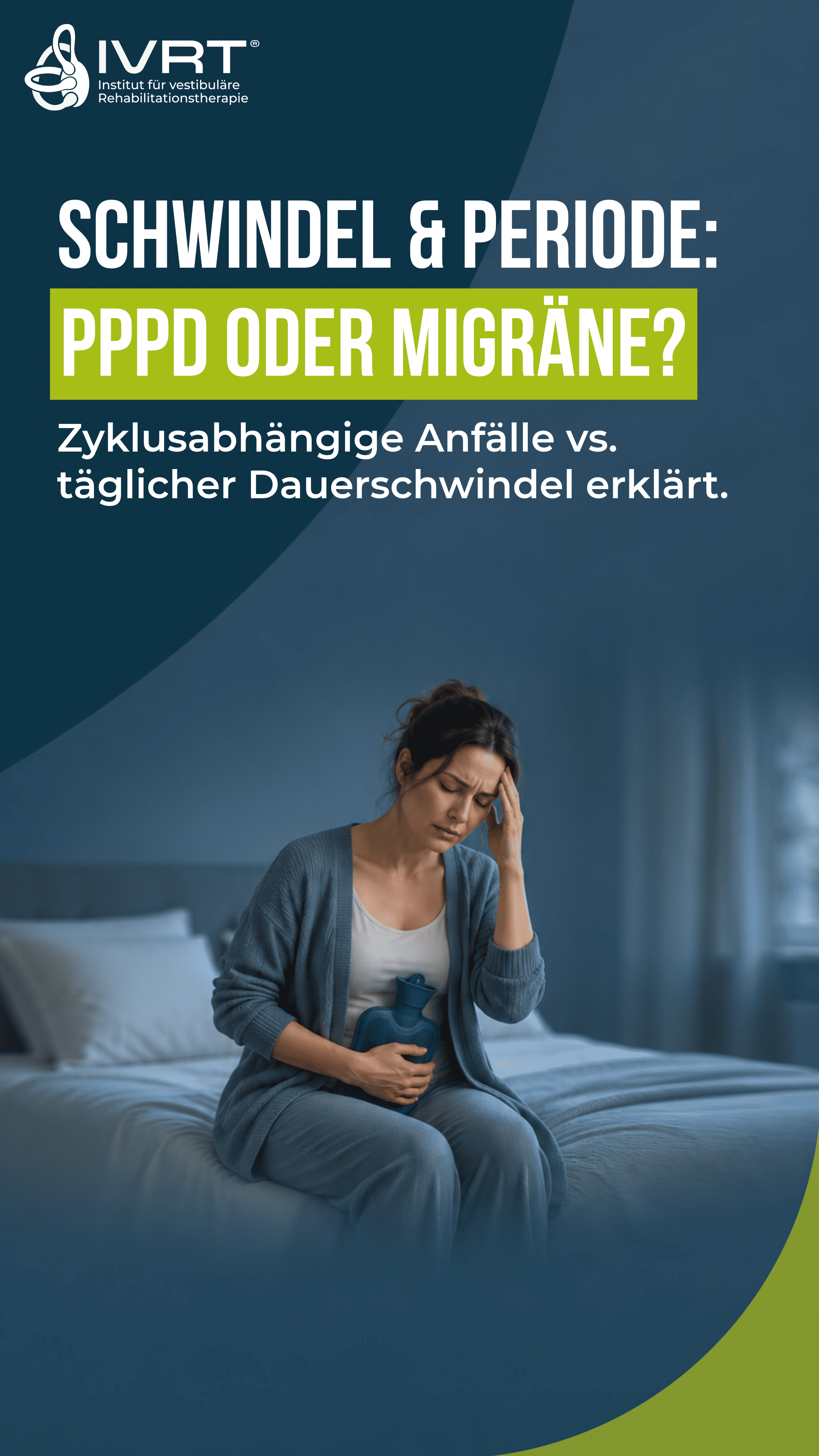
Does your dizziness occur regularly around the time of menstruation, or do you suffer from a constant, daily fluctuation? Hormonal fluctuations play a crucial role in dizziness and provide an important clue for differentiating between vestibular migraine and PPPD.
ㅤ
The most important facts about the cycle, migraines, and persistent dizziness:
Accurate differentiation is decisive: Only when both diagnostic criteria are precisely matched can the therapy be optimally adjusted, e.g., by a combination of medication-based migraine prophylaxis and targeted therapy. vestibular rehabilitation.
Hormonal triggers in vestibular migraine: Many affected women report that their dizziness attacks occur frequently before, during, or immediately after the menstrual period. Severe hormonal fluctuations are a scientifically well-documented main trigger for dizziness migraines.
No cyclical pattern in PPPD: In persistent postural-perceptual dizziness (PPPD), such hormonal dependencies have not yet been scientifically established. Typically, this involves a continuous, daily fluctuation or dizziness of confusion.
Different criteria: Although both disease patterns share similar triggers (such as bright light or supermarkets), they are based on completely different diagnostic criteria.
You can have both: It is by no means uncommon for both disorders to be present simultaneously. Very often, women with vestibular migraine develop secondary PPPD later on – a condition that was previously known as MARD (Migraine Anxiety Related Disorder).
👉 Would you like to understand PPPD in detail? Take a look at our detailed Patient information or that Main video on YouTube Want to understand what vestibular migraine is really about? Then take a look at our Patient information or that Main video Go on YouTube!
📍 Are you looking for qualified therapists near you who specialize in dizziness? Use our Therapist search!
 Deutsch
 English
 Nederlands
 Dansk
 Türkçe

